- New unified knowledge discovery platform enables citizens to explore India’s rich cultural heritage through natural language, multilingual search and AI-generated answers with verified official sources
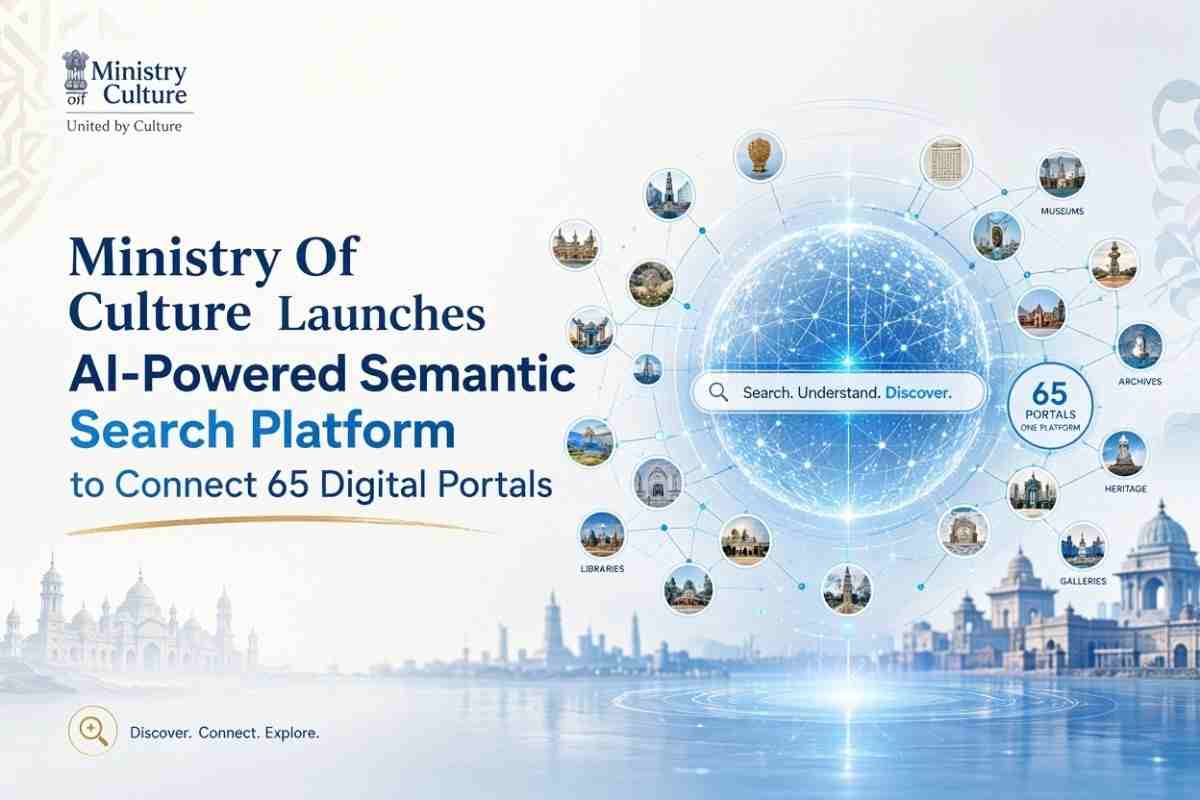
New Delhi: The Ministry of Culture has launched an Artificial Intelligence (AI)-powered Semantic Search and Knowledge Discovery Platform with a conversational assistant on its official website, culture.gov.in, to make India’s vast cultural heritage resources more accessible through a single digital interface.
The initiative aims to bring together information scattered across approximately 65 digital platforms managed by the Ministry, covering archives, manuscripts, museums, monuments, tangible and intangible cultural heritage, art forms, conservation initiatives, commemorative programmes and flagship national campaigns.
Powered by Artificial Intelligence (AI), Natural Language Processing (NLP), knowledge graphs, embeddings and Retrieval-Augmented Generation (RAG), the platform goes beyond conventional keyword-based searches to understand users’ questions, intent and contextual requirements.
Citizens can now search for cultural information using everyday language without knowing the names of individual portals or specific search terms. For instance, a user can simply ask, “Which manuscripts on Ayurveda are held in national collections?” and receive relevant information gathered from the Ministry’s digital repositories.
One Search Interface Across 65 Digital Platforms
The platform provides a unified semantic search experience, bringing relevant information from multiple Ministry portals into one consolidated response. It is designed to simplify access to India’s extensive cultural knowledge resources and reduce the need to visit multiple websites individually.
The search results include AI-generated summaries, detailed explanations, source references, multilingual translations and relevant multimedia content, including photographs, artefacts and archival documents.
A key feature is its source-based response system. Each factual statement is accompanied by numbered citations linking users directly to the original Ministry webpage or source record. This enables citizens to verify information easily.
The platform operates exclusively on official Ministry sources, following a grounded AI approach. It does not rely on open-internet information to generate answers and is designed to acknowledge gaps in available information rather than produce unsupported responses.
Live Access to Major National Cultural Repositories
For some of the Ministry’s largest digital repositories, including Gyan Bharatam, Abhilekh Patal, Indian Culture and Mera Gaon Meri Dharohar, the platform supports live portal-level queries.
This capability enables users to retrieve relevant archival and cultural records directly from these databases at the time of their search, improving access to information that may otherwise be difficult to locate through conventional search methods.
The assistant also supports conversational interactions, allowing users to ask follow-up questions and explore subjects in greater detail without repeating their earlier queries.
Multilingual and Voice-Based Access
To make cultural information more inclusive and accessible, the platform incorporates voice-based search and natural Indian voice responses. Users can ask questions verbally and listen to answers, helping improve accessibility for people with low literacy levels and visual impairments.
Built with the support of Bhashini, the Government of India’s national language technology platform, the solution aims to serve citizens across all 22 scheduled Indian languages.
Another important feature is that the platform does not require users to log in or register. Citizens can access the service directly without creating an account or personal profile.
Open-Source Architecture and Future-Ready AI Framework
The platform has been developed using open-source foundation models and follows an LLM-agnostic architecture. This ensures that the system is not dependent on a single large language model and can adapt to emerging technologies, including Indian sovereign AI models.
The flexible architecture is intended to support future technological advancements while strengthening India’s digital public infrastructure for cultural knowledge and heritage discovery.
By integrating multiple digital repositories into a single intelligent interface, the Ministry of Culture is taking a significant step towards making India’s cultural resources easier to discover, understand and access for citizens, researchers, students and heritage enthusiasts.
Frequently Asked Questions (FAQs)
1. What is the AI-powered Semantic Search Platform of the Ministry of Culture?
It is an AI-enabled search and conversational assistant integrated into the Ministry of Culture’s official website, culture.gov.in. It allows users to discover information across approximately 65 Ministry-managed digital platforms through a single interface.
2. What kind of information can users search for?
Users can explore information related to:
Historical archives and manuscripts.
- Museums, monuments and archaeological heritage.
- Tangible and intangible cultural heritage.
- Traditional art forms and cultural practices.
- Preservation and conservation initiatives.
- Commemorative programmes and national campaigns.
- Digital collections, photographs and archival records.
3. How does the platform understand user questions?
The platform uses Natural Language Processing (NLP), semantic embeddings, knowledge graphs and Retrieval-Augmented Generation (RAG) to understand the meaning, intent and context of questions asked in everyday language.
4. Does the platform search multiple Ministry portals simultaneously?
Yes. It brings together relevant information from approximately 65 digital platforms, enabling users to discover information without visiting each portal separately.
5. Are the answers generated by AI verifiable?
Yes. The platform provides numbered citations and links to the original Ministry sources, allowing users to verify the information and access the relevant webpages or records.
6. Does the AI assistant use information from the open internet?
No. The platform is designed to generate answers using official Ministry of Culture digital resources. This grounded AI approach helps ensure that responses remain connected to authoritative sources.
7. Can users access archival records through live searches?
Yes. The platform supports live queries for major repositories, including Gyan Bharatam, Abhilekh Patal, Indian Culture and Mera Gaon Meri Dharohar, helping users discover relevant records directly from these databases.
8. Does the platform support Indian languages?
Yes. With integration support from Bhashini, the platform aims to support all 22 scheduled Indian languages through multilingual capabilities.
9. Can users interact with the assistant through voice?
Yes. Users can ask questions through voice input and listen to responses delivered in a natural Indian voice, improving accessibility for people with visual impairments and low literacy levels.
10. Is registration required to use the platform?
No. The platform is accessible without login, registration or the creation of a personal user profile.
11. What technologies power the platform?
The platform uses Artificial Intelligence, Natural Language Processing, semantic embeddings, knowledge graphs and Retrieval-Augmented Generation (RAG), supported by open-source foundation models.
12. Is the platform compatible with future AI technologies?
Yes. Its LLM-agnostic architecture allows flexibility in adopting emerging large language models, including future Indian sovereign AI models.
13. Who can benefit from this platform?
Citizens, students, researchers, historians, academicians, cultural practitioners, tourists and heritage enthusiasts can use the platform to explore India’s diverse cultural and historical resources.
14. Where can citizens access the AI-powered search platform?
Citizens can access the Ministry of Culture’s digital platform through its official website: