- PM Modi said on Independence Day that what has not been achieved in last 5-7 decades, we must accomplish in next 5-7 years; only then will we be able to secure our place in global competition
- Modi government has made Regional Councils a meaningful platform; in 70 meetings held from 2014 till now, approximately 80% of 1869 issues have been resolved
- Main foundation of India’s progress is development of southern states, which rests on three pillars – high literacy rate, trained manpower and technical expertise in utilisation of the deep sea – while their progress depends on water
- Union Home Minister emphasizes on resolving pending water issues of southern states at earliest by holding joint meetings with concerned states through Ministry of Jal Shakti, Ministry of Home Affairs and Inter-State Council
- We have succeeded in making water-related issues dispute-free across entire North India; we will also have to think afresh on issues of water sharing in South India
- States agreed to the suggestions made by Union Home Minister to resolve pending water disputes among southern states at earliest through mutual dialogue and a positive approach to dispute resolution
- Andhra Pradesh and Telangana agreed to resolve issues related to division of assets and liabilities in consultation with Ministry of Home Affairs
- There is nothing wrong with protecting interests of one’s own state, but if protecting those interests means that states do not get water for years, then no one’s interests are truly being protected
- If great rivers of India, from Brahmaputra to Cauvery and Godavari, are interconnected, India may not face any water shortage for the next 100 years
- Fast Track Special Courts are a highly sensitive and critical issue for prompt investigation of crimes against women and children and speedy disposal of rape and POCSO cases
- Malnutrition, stunting and school dropout ratio are crucial for future generations, spirit of Constitution can truly be realised only when tdropout ratio falls below 3%
- A drug-free India is need of every state government and society, MHA has prepared a three-year roadmap, and without involvement of all departments, we will not be able to protect the coming generation
New Delhi. : Union Home Minister and Minister of Cooperation Shri Amit Shah chaired the 31st meeting of the Southern Zonal Council in Mahabalipuram, Tamil Nadu. The meeting was attended by Tamil Nadu Chief Minister Shri C. Joseph Vijay, Andhra Pradesh Chief Minister Shri Chandrababu Naidu, Karnataka Chief Minister Shri D. K. Shivakumar, Keralam Chief Minister Shri V. D. Satheesan, Puducherry Lieutenant Governor Shri K. Kailashnathan, Andaman and Nicobar Islands Lieutenant Governor Admiral (Retd.) D. K. Joshi Lakshadweep Administrator Shri Praful Patel, and the Deputy Chief Minister of Telangana Shri Bhatti Vikramarka Mallu. Chief Secretaries, Advisors and other senior officers of the state governments, as well as senior officers of the Central Government, also attended the meeting.
Addressing the meeting, Union Home Minister and Minister of Cooperation Shri Amit Shah said that this region of South India is a very important region for the development of the country. He said that whether it is literature, Research and Development (R&D), space, IT, AI, industrial development or agriculture, South India has always contributed in every sector. South India has played a very major role in all areas of the country’s IT, automobiles, pharmaceuticals and infrastructure development, and that is why a large amount of foreign direct investment has also come to the South.
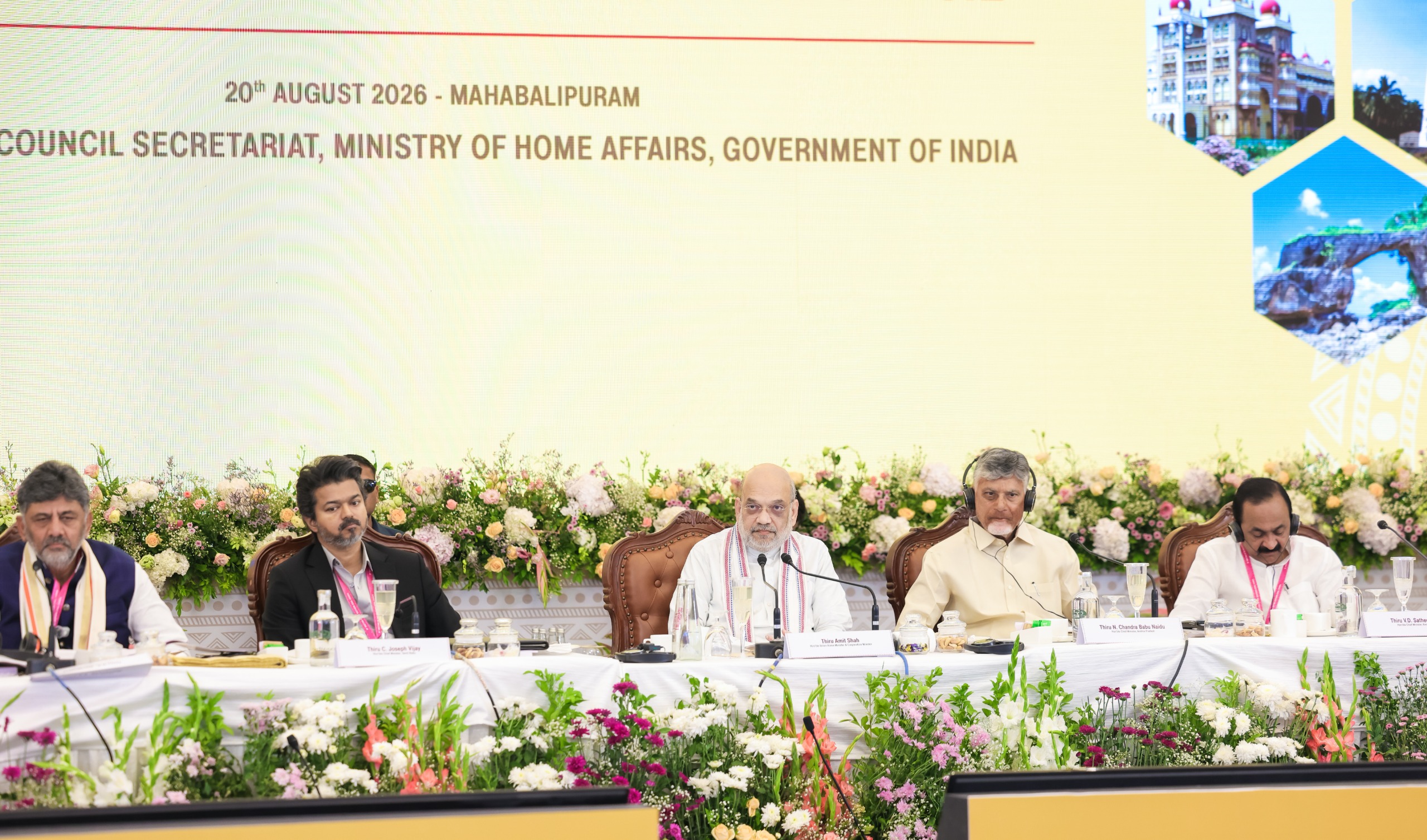
Shri Amit Shah said that the entire development journey of South India has been based on three pillars — high literacy rate, trained manpower and technical expertise in the utilisation of deep seas. These three pillars have made South India the biggest contributor to the country’s development. The people of South India and the governments have also established many excellent traditions in the fields of innovation and revenue generation. He said that the whole of India should learn from South India in these two areas.
Union Home Minister said that on the occasion of the 80th Independence Day, Prime Minister Shri Narendra Modi has stated that what has not been achieved in the last seven decades, we must accomplish in the next five to seven years; only then will we be able to secure our place in the global competition. To achieve such development, every state will have to contribute to it.
RFFW.jpeg)
Shri Amit Shah said that since 2014, efforts have been made to transform the Zonal Council into a meaningful platform. The Zonal Council is essentially a constitutional mechanism that, over a long period, had gradually been reduced to a mere formality. Comparing the periods of 2004-2014 and 2014-2026, he said that while the Council previously held an average of two and a half meetings annually, it now holds six meetings each year. He mentioned that a total of 70 Zonal Council meetings have taken place since 2014, during which 1,445 out of 1,869 issues, approximately 80%, were resolved. Shri Shah added that many issues pending for 60 years have been settled through these Zonal Council meetings.
Union Home Minister said that in North India five out of the eight issues related to sharing of river waters had been persisting since the pre-British era. A final agreement was reached five months ago, and by resolving 100% of the issues, spanning from Kashmir to Uttar Pradesh, a dispute-free North India has been achieved.
7FHA.jpeg)
Shri Amit Shah said that the southern states are the main pillars of the country’s progress, and the progress of the southern states depends on water. Whether it is agriculture, industry, healthy citizens or the environment, water is the soul of this region in all these four areas.
Shri Amit Shah observed that protecting the interests of one’s state is not wrong; however, if the process of protecting interests results in states being deprived of water for years while it simply flows into the sea, then no actual interest is being served. He said that linking major rivers, from the Brahmaputra to the Kaveri and Godavari, could ensure that India faces no water shortage for the next 100 years. This initiative could also facilitate the creation of multiple waterways, which would not only save fuel and improve the environment but also provide a cost-effective transportation system.
Union Home Minister Shri Amit Shah emphasized the need for the early resolution of pending water-related issues concerning southern states through joint meetings involving the Ministry of Jal Shakti, the Ministry of Home Affairs, the Inter-State Council, and the respective states. The southern states agreed with the Home Minister’s suggestion to resolve these pending water disputes expeditiously through mutual dialogue and constructive solutions. Regarding issues concerning the division of assets and liabilities between Andhra Pradesh and Telangana, both states agreed to resolve these matters in consultation with the Ministry of Home Affairs.
Shri Amit Shah said that the swift investigation of cases of rape against women and children, and the early disposal of rape and POCSO cases through the implementation of Fast Track Special Courts (FTSC) are very sensitive issues. He said that these issues need to be viewed with great sensitivity at the level of the Chief Ministers. The Home Minister said that after the introduction of the new criminal laws, many tools have become available to us for accelerating the entire process.
Home Minister said that malnutrition, stunting and the school dropout ratio are very important for our future generations. We should not be satisfied with anything less than 100 per cent in addressing the school dropout ratio. Shri Shah said that currently the school dropout ratio for the entire country stands at 9.5, and if all states make even incremental improvements, we can bring it down below 3 per cent. He said that if the national dropout ratio goes below 3 per cent, children will become educated citizens and a conducive environment will be created in the country for implementing the spirit of the Constitution in its true sense down to the grassroots.
Union Home Minister said that we must also pay special attention to malnutrition. In a way, nutrition schemes are also linked to the school dropout ratio. He further said that we are moving towards an even more dangerous problem of stunting, that is, stunted growth. This appears to be gradually becoming a national problem that can impair the capabilities of our future generations. Therefore, we must take malnutrition and stunting very seriously. Shri Shah said that the fight against malnutrition was initiated by Tamil Nadu and Andhra Pradesh, which was eventually accepted across the country. Now there is a need to pay special attention to it. After 80 years of independence, we cannot place the burden of malnourished children on this country. If implementation is carried out with sensitivity at the Chief Minister level on this issue, the country can be freed from this problem. He said that it is the responsibility of all of us to contribute towards building an educated and healthy India.
Shri Amit Shah said that today a drug-free India is a necessity for every government and our society. The Ministry of Home Affairs of the Government of India has prepared a three-year roadmap in which the roles of several departments of the states and the Centre have been defined. Until all departments of the Central Government and all departments of all state governments join this movement, we will not be able to save the coming generation from this evil. He said that it is the responsibility of us all to contribute towards building an educated and healthy India.