New Delhi. : The Council of Scientific and Industrial Research (CSIR) organised a Technology Transfer Event at CSIR Headquarters, New Delhi, today, bringing together technologies developed by CSIR-Central Leather Research Institute (CSIR-CLRI), Chennai, and CSIR-Central Road Research Institute (CSIR-CRRI), New Delhi, for transfer to industry.
The event, held at the SSB Auditorium, CSIR Headquarters, included presentations of the technologies by the two laboratories, followed by their transfer to industry. Dr. N. Kalaiselvi, Secretary, Department of Scientific and Industrial Research (DSIR) and Director General, CSIR, addressed the gathering. The programme also included remarks by the Directors of CSIR-CLRI and CSIR-CRRI.
The technologies showcased for transfer reflect CSIR’s continuing emphasis on taking laboratory-developed solutions towards industrial deployment and addressing challenges relating to sustainability, circular economy, waste utilisation, road safety and infrastructure.
CSIR-CLRI technologies turn industrial waste into valuable resources
CSIR-CLRI presented a technology for producing protein-based syntans from chrome shavings, addressing an important waste-management challenge of the leather industry. Chrome shavings are a non-biodegradable solid waste, but they contain valuable collagen protein that often remains underutilised. The CSIR-CLRI process recovers chromium-free protein hydrolysate from this waste and converts it into acrylic-, phenolic- and melamine-based syntans that can be reused in leather retanning.
The technology has been demonstrated at the 100–200 kg pilot scale and validated at a commercial scale of 1,500 kg. According to CSIR-CLRI, its adoption can lead to up to 50 per cent reduction in total dissolved solids (TDS) in the post-tanning stream. The patented technology has been industry-validated and is ready for commercial licensing.
Another CSIR-CLRI technology focuses on the sustainable valorisation of spent pickling acid, a highly acidic waste stream generated during steel processing. The process enables recovery of iron and chloride from spent pickling acid and their conversion into value-added products, including pigment-grade iron oxide and ammonium chloride.
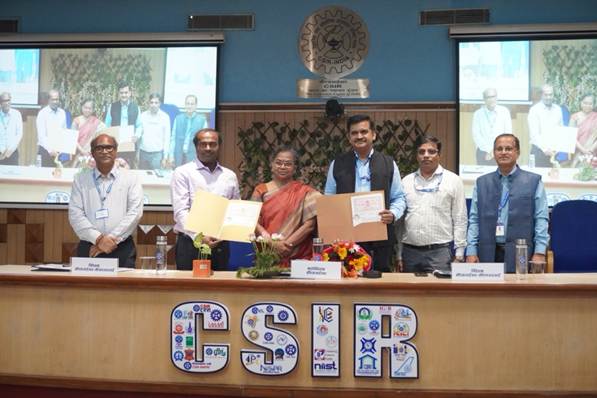
The technology seeks to convert a hazardous industrial waste into commercially useful products while reducing environmental pollution and strengthening domestic manufacturing. It is aligned with circular-economy principles and contributes to Sustainable Development Goals relating to clean water and sanitation, industry and innovation, and responsible consumption and production.
CSIR-CRRI technologies address road safety and pothole repair
CSIR-CRRI presented two technologies for transfer to industry: ClariVisor – A Glare Mitigation Device for Four-Wheelers and a Two Pack Onsite Pothole Filling Mix.
ClariVisor is designed as an in-vehicle glare mitigation solution for four-wheelers. The technology has been designed for fitment within the same footprint as the vehicle’s original equipment manufacturer (OEM) sun visor, without requiring structural changes to the vehicle.
The Two Pack Onsite Pothole Filling Mix offers a cold-application approach to road repair. The material is supplied in two separate packs for on-site blending and immediate application. Unlike conventional hot-mix approaches, it does not require a hot-mix plant or heating, thereby reducing energy consumption and emissions. The technology is solvent-free and enables faster repair and early reopening of roads to traffic.
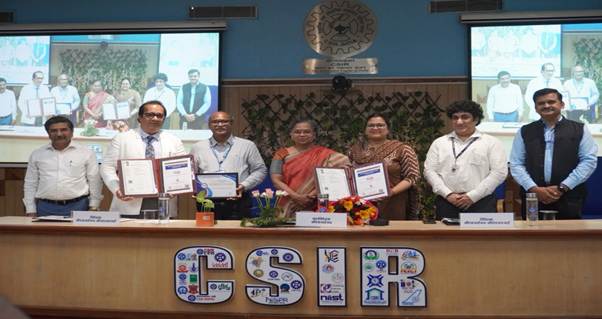
The technologies being transferred build on CSIR-CRRI’s wider portfolio of innovations in sustainable and resilient road infrastructure.
Addressing the gathering, Dr. N. Kalaiselvi emphasised the importance of accelerating the translation of CSIR technologies from laboratories to industry and ensuring that scientific research delivers tangible societal, environmental and economic impact. The DG, CSIR highlighted that stronger partnerships between CSIR laboratories and industry are essential for scaling indigenous technologies and enhancing their reach and impact.
The Technology Transfer Event underscores CSIR’s focus on strengthening industry partnerships and moving proven indigenous technologies towards wider commercial deployment. Through such technology transfers, CSIR continues to advance its mandate of translating science and technology into solutions that contribute to sustainable industrial development, improved infrastructure and national economic growth.