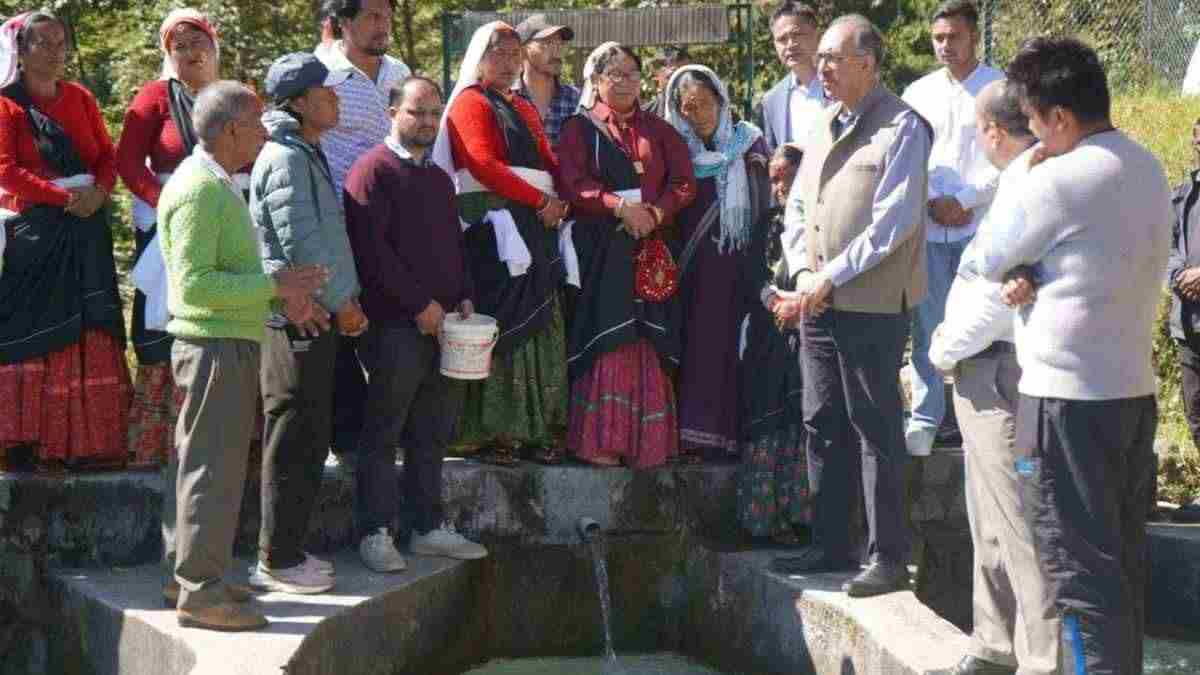
Uttarakhand : Dr. Abhilaksh Likhi, Secretary, Department of Fisheries, Ministry of Fisheries, Animal Husbandry & Dairying, Government of India, undertook an official visit to Munsyari, district Pithoragarh, Uttarakhand, on 18 October 2026 to review the progress of coldwater aquaculture development in the Himalayan region.
During the visit, the Secretary interacted with trout farmers at Johar Matsya Swayatt Sehkarita, Namjala Trout Farm, Munsyari, and appreciated the pioneering role of local cooperatives in adopting rainbow trout farming as a sustainable livelihood option. He noted that Munsiyari, with its glacial streams of the Gori Ganga and ideal water temperature, has emerged as a hub for rainbow trout culture, transforming subsistence farming into a semi‑commercial enterprise.Dr. Likhi interacted with trout fish farmers, who shared their experiences and insights on trout farming in the region.
the Government of India has notified 34 fisheries clusters across the country. Pithoragarh has been notified as a Cold Water Fisheries Cluster under PMMSY, with significant potential to strengthen fisheries cooperatives, enhance livelihood opportunities and promote sustainable fisheries development in the Himalayan region.The visit by the Secretary, Department of Fisheries, marks an important step towards further strengthening trout farming in Uttarakhand and other Himalayan regions.The Department of Fisheries, Government of Uttarakhand, is exporting trout to Nepal and supplying trout to the Indo-Tibetan Border Police (ITBP) under an MoU entered between the Government of Uttarakhand and ITBP.
The Secretary highlighted that coldwater fisheries in hilly states such as Uttarakhand, Himachal Pradesh, Jammu & Kashmir, Ladakh, Sikkim, and Arunachal Pradesh are of strategic importance for livelihood diversification, nutritional security, and export potential.He emphasized that the Government of India, under the Pradhan Mantri Matsya Sampada Yojana (PMMSY), has invested over ₹2,299 crore in coldwater regions, supporting raceways, hatcheries, feed mills, cold storages, and post‑harvest infrastructure.
India’s coldwater fisheries are concentrated in six hilly states and UTs — Uttarakhand, Himachal Pradesh, Jammu & Kashmir, Ladakh, Sikkim, and Arunachal Pradesh. These regions, with their glaciated rivers, high‑altitude lakes, and pristine streams, provide ideal ecological conditions for rainbow trout and other high‑value coldwater species. Under PMMSY, more than 5,600 raceways, 54 hatcheries, 293 cold storages, and 260 feed mills have been sanctioned across these states. Trout production has grown six‑fold in the last decade, reaching nearly 5,000 MT annually, with Uttarakhand achieving its first international export to Nepal in June 2026.
In Uttarakhand, projects worth ₹317 crore have been sanctioned, including modern fish markets, landing centres, and an integrated aquapark at Sitarganj. The state has also launched the Trout Protsahan Yojna with an outlay of ₹170 crore, aiming to establish 1,500 raceways, 100 mini hatcheries, and 600 cold‑storage facilities by 2028–29.
The Secretary commended the role of ICAR‑Central Institute of Coldwater Fisheries Research (DCFR), Bhimtal, in introducing rainbow trout to Munsiyari and providing scientific support in seed production, disease management, and farmer training. He also appreciated the historic achievement of Uttarakhand’s first trout export to Nepal in June 2026, which has opened new avenues for international trade.
The visit also underscored the socio‑economic impact of trout farming in border villages, providing livelihood diversification, eco‑tourism opportunities, and assured institutional market linkages with the Indo‑Tibetan Border Police (ITBP).
He underlined that coldwater aquaculture is not only enhancing farmers’ incomes but also contributing to eco‑tourism, conservation of endangered species like Mahseer, and strengthening border village economies.