- BRICS Energy Ministers reaffirmed the importance of respecting national circumstances, development priorities and energy pathways
- The meeting concluded with the adoption of the 11th BRICS Energy Ministers’ Joint Communiqué, reflecting the collective vision and consensus of BRICS countries
- A major outcome of India’s Chairship was the launch of the BRICS Digital Centre of Excellence for Smart Grids and Energy Storage
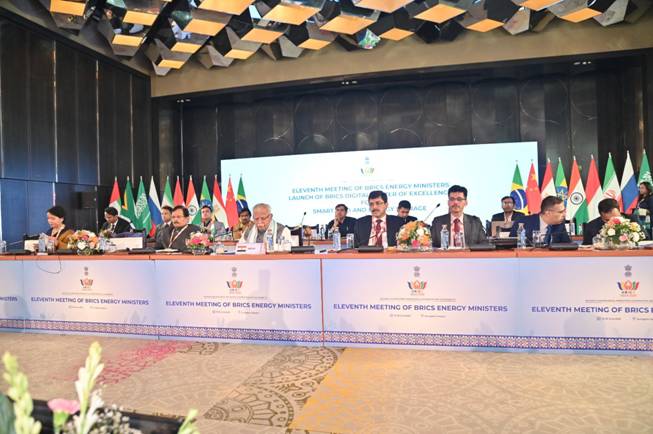
New Delhi. : The 11th BRICS Energy Ministers’ Meeting was successfully convened on 25 June 2026 in Gurugram, Haryana, under India’s BRICS Chairship 2026 under the overarching theme “Building for Resilience, Innovation, Cooperation and Sustainability.”
The meeting brought together Energy Ministers, Vice Ministers, and senior officials from BRICS member countries to deliberate on key global energy challenges and opportunities and to advance practical cooperation across the energy sector. Representatives from leading international organizations, including the International Solar Alliance (ISA), the Global Biofuels Alliance (GBA) the New Development Bank (NDB), also participated in the deliberations.
Guided by the Energy Track theme “सर्वेषां ऊर्जम् (Energy for All)”, the discussions focused on three priority areas:
Priority 1: Energy Security and Sustainability, focusing on resilient energy systems, diversified energy sources, critical minerals, supply chain resilience, grid modernization, energy storage, and secure, affordable energy supplies.
Priority 2: Energy Access and Equity, focusing on universal access to affordable, reliable, sustainable and modern energy, clean cooking solutions, affordable financing, capacity building, and support for emerging markets and developing economies.
Priority 3: Technology and Innovation, focusing on smart grids, energy storage, hydrogen value chains, digitalization of energy systems, artificial intelligence, energy efficiency, biofuels, carbon capture technologies, and strengthening research and innovation cooperation across BRICS countries.
BRICS Energy Ministers reaffirmed the importance of respecting national circumstances, development priorities and energy pathways.
The meeting concluded with the adoption of the 11th BRICS Energy Ministers’ Joint Communiqué, reflecting the collective vision and consensus of BRICS countries on strengthening cooperation in the areas of energy security, sustainability, innovation, resilient infrastructure and capacity building.
India’s Energy Transformation and Global Leadership
Addressing the Ministerial Meeting, Union Minister of Power and Housing & Urban Affairs Shri Manohar Lal highlighted that energy remains fundamental to economic growth, social progress and human development. He emphasized that developing countries require adequate time, resources and policy space to pursue sustainable development while meeting the legitimate aspirations of their people. He underlined India’s commitment to building resilient, future-ready and people-centric energy systems guided by the principle of “सर्वेषां ऊर्जम्” – Energy for All.
The Minister showcased India’s energy transformation over the last decade, noting that the country has emerged as the world’s third-largest producer and consumer of electricity, with installed power capacity reaching nearly 540 GW and non-fossil sources accounting for more than half of the installed capacity. He highlighted India’s rapid clean energy expansion, with solar capacity increasing from about 3 GW in 2014 to more than 154 GW today, and underscored the role of flagship initiatives such as PM Surya Ghar: Muft Bijli Yojana in accelerating rooftop solar adoption and promoting citizen participation in the energy transition.
He highlighted India’s ambitions to achieve over 400 GWh of energy storage capacity by 2032 and 100 GW of nuclear power capacity by 2047, alongside its achievement of 20 per cent ethanol blending ahead of schedule and leadership in initiatives such as the Global Biofuels Alliance and the International Solar Alliance.
Outcomes Delivered during India’s BRICS Chairship
A major outcome of India’s Chairship was the launch of the BRICS Digital Centre of Excellence for Smart Grids and Energy Storage (https://brics-dcoe.global/) under the BRICS Energy Research Cooperation Platform (ERCP). The Centre will serve as a voluntary collaborative platform for knowledge sharing, capacity building, exchange of policy and regulatory best practices, and development of pilot initiatives among BRICS countries.
In another significant milestone, the BRICS Guiding Principles on Smart Grids and Energy Storage were adopted recognizing the growing importance of modern, resilient and digitally enabled power systems in supporting reliable and affordable energy access while facilitating the integration of renewable energy and emerging technologies.
The Ministers also appreciated the ongoing efforts in finalization of the BRICS Joint Report on Hydrogen Value Chains 2026, which provides a foundation for enhanced cooperation on hydrogen technologies, standards, industrial applications and future value chains.
The meeting further endorsed the updated Terms of Reference of the BRICS Energy Research Cooperation Platform (ERCP), strengthening the institutional framework for research, technical cooperation and knowledge exchange among BRICS countries.
The successful outcomes of the 11th BRICS Energy Ministers’ Meeting were supported by multiple rounds of consultations held at the level of Senior Energy Officials under India’s Chairship. These engagements facilitated detailed discussions and consensus-building across the priority areas contributing significantly to the outcomes adopted at the Ministerial Meeting.
As part of the Senior Energy Officials’ Meeting, India also hosted two side events on Clean Coal Technologies and Raising Electrical Appliance Standards. The discussions brought together senior energy officials from BRICS member countries, policymakers, industry leaders, experts and international organizations, and provided a platform for sharing experiences, best practices and innovative approaches to enhancing energy security, sustainability and energy efficiency across BRICS countries.
Joint Communiqué Reaffirms Shared Commitment to Energy Security, Equity and Innovation
The Joint Communiqué reaffirmed that energy security remains a cornerstone of BRICS cooperation and emphasized the need for diversified, resilient and transparent energy systems and supply chains.
Ministers highlighted that access to secure, reliable, affordable, and sustainable energy is fundamental to economic development, job creation, industrialization, and human dignity.
The Ministers also underscored the importance of balanced and diversified energy mixes, promotion of cleaner and more efficient energy technologies, and cooperation in areas such as new technologies in fossil fuels, renewable energy, biofuels, hydrogen, energy storage, critical minerals, carbon capture technologies, digitalization and energy efficiency while reaffirming the importance of affordable financing.
Recognizing the role of research and youth engagement in shaping future energy systems, the Ministers supported the convening of the BRICS Youth Energy Summit during India’s Chairship and reaffirmed their commitment to expanding collaboration through the BRICS Energy Research Cooperation Platform.
The Ministers appreciated India’s efforts in successfully hosting the 11th BRICS Energy Ministers’ Meeting and its leadership in advancing BRICS energy cooperation during its Presidency. They reaffirmed their commitment to deepening collaboration in support of secure, affordable, sustainable and resilient energy systems and looked forward to continuing cooperation under the Chairship of the People’s Republic of China in 2027.