New Delhi: India’s infrastructure expansion is creating demand for professionals who can do more than oversee construction. Project financing, technology integration, sustainability, commercial management and long-term asset planning are becoming increasingly important to the successful delivery of complex projects. Against this changing industry landscape, the National Institute of Construction Management and Research (NICMAR) has introduced a new brand identity to reflect its evolving institutional vision.
The refreshed identity marks a new chapter for NICMAR, an institution with more than four decades of experience in specialised education across Construction, Real Estate, Infrastructure and Project Management (CRIP). The rebranding aims to bring its entities under one cohesive institutional identity while positioning the institute for the demands of India’s next infrastructure growth phase.
According to the institute, the exercise is driven by two priorities: modernisation and unification. It is intended to give NICMAR a contemporary visual presence while maintaining its connection with its established academic legacy.
Why NICMAR Has Introduced a New Brand Identity
The rebranding comes at a time when India’s built environment is undergoing significant changes. Infrastructure projects are becoming more complex, requiring coordination between engineering, finance, technology, contracts and risk management.
NICMAR’s refreshed identity seeks to reflect this wider professional landscape. Rather than presenting the institution only through its traditional association with construction and project management education, the new positioning highlights the broader capabilities needed to plan, develop and manage modern infrastructure.
The unified branding is also expected to create a more consistent institutional presence across NICMAR’s entities and stakeholder interactions.
India’s Infrastructure Investment Creates Demand for Skilled Professionals
The economic context provides an important backdrop to NICMAR’s repositioning.
The Union Budget 2026–27 allocated ₹12.22 lakh crore towards public capital expenditure. Meanwhile, the government’s National Monetisation Pipeline 2.0 estimates a monetisation potential of ₹16.72 lakh crore between FY2026 and FY2030.
These figures point to the scale of investment and asset-management opportunities expected across India’s infrastructure ecosystem.
However, investment alone does not guarantee successful project delivery. Infrastructure developers, contractors, investors and project owners require professionals capable of managing budgets, timelines, contractual obligations and execution risks.
NICMAR sees this changing requirement as an opportunity to strengthen its contribution to professional education and industry-oriented skill development.
AI, Digital Construction and Sustainability Shape NICMAR’s Future Vision
The institute’s future-facing approach also reflects technological and environmental changes across the built environment.
AI-enabled project controls, digital construction, climate resilience, emerging real estate asset classes and infrastructure asset management are expanding the skill sets expected from industry professionals.
NICMAR aims to strengthen the relationship between academic learning, applied research and industry requirements through greater collaboration, practical learning opportunities and specialised capabilities.
This direction reflects a broader shift in construction and infrastructure management: professionals increasingly need to combine technical knowledge with commercial understanding, digital skills and the ability to manage complex projects.
What NICMAR Leadership Said About the Rebranding
Dr. Tapash Kumar Ganguli, Director General of NICMAR, said the institution must prepare professionals not only for immediate industry requirements but also for the infrastructure capabilities India will need over the coming decades.
He highlighted the importance of combining engineering knowledge, technology, financial discipline and effective project management to meet the country’s long-term infrastructure ambitions.
Mr. Gaurav Bajpai, Director and Head of Admissions and Marketing at NICMAR, described the rebranding as an important step in how the institution presents itself while remaining connected to its legacy.
He also explained that the brand film traces NICMAR’s journey from its beginnings to its contribution to India’s development, while introducing the thinking behind the refreshed visual identity.
Landor Conceptualises the New Identity; Brand Film Released
The rebranding was conceptualised by Landor, a brand consulting and design firm.
Alongside the refreshed identity, NICMAR has developed a dedicated brand film that traces the institute’s journey from its inception in 1983 to its aspirations for the future.
The new visual language includes an evolved colour palette, integrated typography and an adaptable design approach intended for use across different platforms and formats.
NICMAR’s Legacy and the Road Ahead
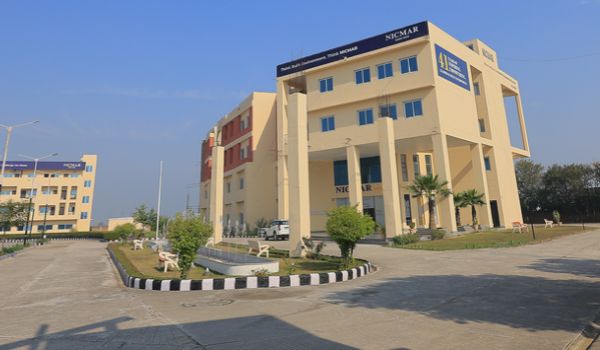
Established in 1983, NICMAR is an autonomous, non-governmental and not-for-profit institution specialising in CRIP education. It has developed an institutional presence through its campuses in Pune and Hyderabad, alongside a wider presence across Pune, Hyderabad, Delhi-NCR and Mumbai.
With its new brand identity, NICMAR is signalling an ambition to remain relevant as India’s infrastructure requirements evolve.
The next phase will depend on how effectively the institute translates this positioning into academic programmes, industry partnerships, applied research and professional development.
As India advances towards its Viksit Bharat ambition, the ability to plan, finance, build and manage infrastructure efficiently will remain central to long-term development. NICMAR’s refreshed identity places the institution’s future direction within that larger national priority.