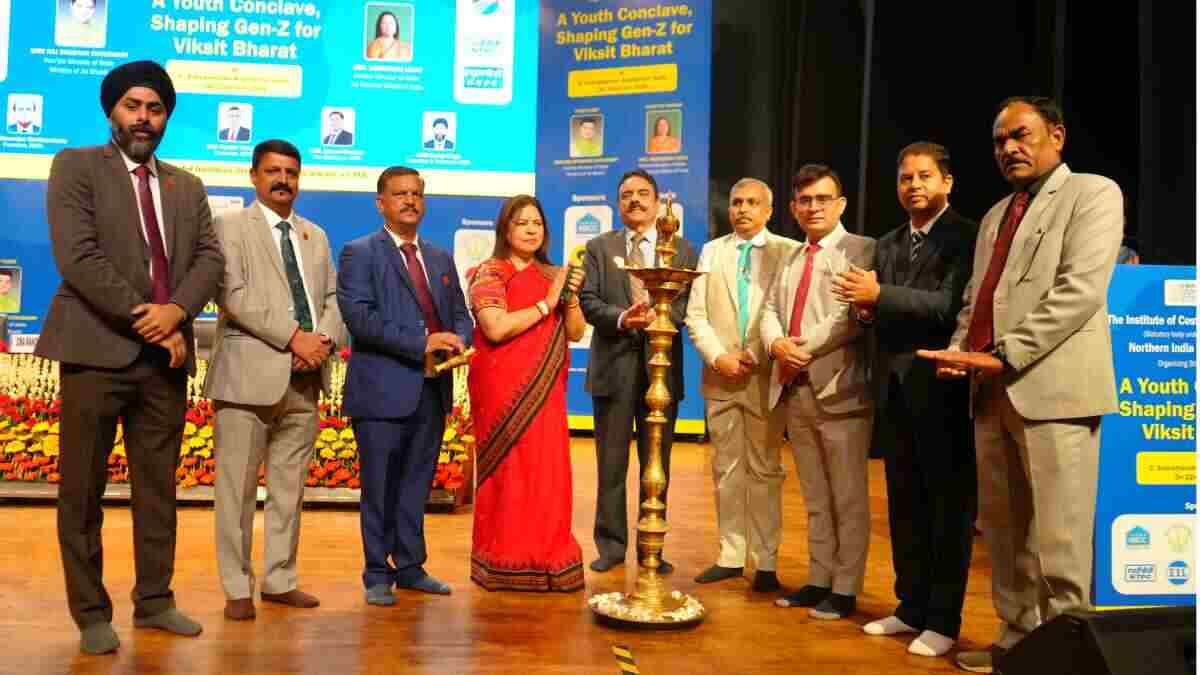
New Delhi, October 22, 2026: BJP MP Meenakshi Lekhi on Thursday appealed to newly qualified students not to allow themselves to be labelled as “Gen Z”, but to identify as the “Amrit Peedhi”, in whose hands the keys to the country’s treasury would eventually be placed.
Addressing newly qualified students from the Institute of Cost Accountants of India (ICMAI) at a student convention themed “Shaping Gen Z for Viksit Bharat”, Lekhi told the students that they were the leaders of the country and that the future belonged to them.
Set up in 1944, ICMAI is the largest cost and management accounting body in the world, with more than 6 lakh students and 1 lakh qualified professionals globally. At the student convention organised by the Northern India Regional Council (NIRC) of ICMAI, more than 700 qualifying students were felicitated on Thursday.
“Don’t allow others to label you. I want you to condemn the word ‘Gen Z’. You are Amrit Peedhi. What does Gen Z mean? What do Gen Alpha, Beta and Gamma mean? Who decided which generation is what? You are 20-21 years old right now. In 2014, you must have been nine or 10 years old. At that time, you probably didn’t even know what was happening in the country or what the condition of the country was.
“You are the leaders of this country. The future belongs to you. We cannot hand over the keys to our household treasury to a thief. We have to put the keys to the country’s treasury in your hands. You have to take care of it. Don’t let anybody else define what this generation will be called,” she said.
NIRC Chairman Manish Kandpal Emphasises Skill Development and Employability
Manish Kandpal, Chairman, NIRC, said at the convention that the vision of Viksit Bharat was possible only when the youth were skilled and employable.
“We at NIRC have initiated a movement towards skill development and entrepreneurship. The vision is to channelise the energy of youth for making the country a ‘Viksit Bharat’, which is only possible if we are committed to making them skilled and employable.”
“By combining knowledge, innovation, ethical leadership and financial discipline with entrepreneurial thinking, our youth can transform challenges into opportunities and contribute to inclusive, sustainable national growth. The mission of Viksit Bharat requires young Indians who are not only job-ready but also nation-ready—equipped with skills, integrity and a sense of responsibility to build a stronger, self-reliant India by 2047,” Kandpal said.
Jayant Chaudhary Highlights the Importance of Independent Thinking
Union Minister of State Jayant Chaudhary told students that technology would continue to transform professional tools, but independent thinking, judgement and human integrity would remain invaluable.
“As newly qualified professionals, you must build your expertise, stay curious and never stop questioning assumptions. Technology will continue to transform your tools, but your independent thinking, judgement and integrity will remain invaluable,” the Minister of State for Education and Skill Development said in a virtual address.
“For decades now, ICMAI has played a significant role in developing India’s cost and management accountancy profession. The contribution extends beyond providing financial analysis, helping businesses make more informed decisions about financial structuring to improve efficiencies and create lasting value,” he added.
M. Jagadesh Kumar Calls for Practical Learning in Educational Institutions
Padma awardee educationist M. Jagadesh Kumar, Chairman of the Board of Governors of IIM Calcutta and former UGC Chairman, said that the education system, including universities and colleges, should move away from functioning merely as degree-granting institutions.
“Whenever students pass out of our educational institutions, they should come out with a portfolio of activities. It could be a design, it could be a project, it could be an open-source contribution, or it could be a community interaction.
“In our educational institutions, we need to train our students with abilities such as questioning, validating, testing, designing and explanation. And if our students have these abilities, they can quickly convert data and information into useful knowledge.
“Another sphere where rapid changes are happening is the workplace. Because technology is automating so many activities, you need to focus on higher-order skills such as being creative, developing deep domain knowledge, the ability to work in teams, and the ability to make ethical judgements,” Kumar said.