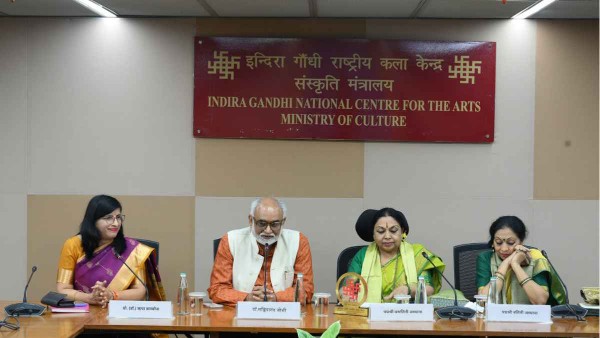
New Delhi, 22 October 2026: The Kaladarshan Division of the Indira Gandhi National Centre for the Arts (IGNCA) organised a special lecture on ‘Aesthetic Sensibility in Dance: The Foundation of Life’ under its lecture series, ‘Indian Art, Aesthetics and Cultural Heritage’. The distinguished speakers were renowned Kathak dancers Padma Shri Nalini Asthana and Padma Shri Kamalini Asthana. Both eminent artists shared their views on the interrelationship between dance, aesthetic sensibility and life. The programme was chaired by Dr Sachchidanand Joshi, Member Secretary, IGNCA. Prof. (Dr) Richa Kamboj, Coordinator and Head of the Kaladarshan Division, delivered the introductory remarks and welcomed the guests.
The two speakers focused on the role of aesthetic sensibility in dance and its wider connection with the philosophy of life. Indian classical dance is not merely an expression of physical movements and rhythm; it is an integrated form of expression that brings together emotion, rasa, sensitivity and spiritual experience. In classical dance traditions such as Kathak, human experiences and the diverse aspects of life are expressed through bodily movements, emotional expression, music and rhythm.
Nalini and Kamalini Asthana said, “Our dance begins with a very fundamental principle — ‘Yato hastastato drishtih, yato drishtistato manah, yato manastato bhavah, yato bhavastato rasah.’ This means that where the hands move, the eyes follow; where the eyes look, the mind follows; where the mind goes, emotions arise; and where emotions arise, rasa is produced. Wherever our mind goes, our emotions become focused there as well. This is where rasa is born. An absence of emotion or rasa is inconceivable in dance. If there is no rasa in dance, it cannot fulfil its fundamental purpose. Dance is inherently imbued with rasa. The question is how we can experience this rasa in our everyday lives. When our mind is fully engaged in an activity, the corresponding emotion arises within us. The activity we think about develops a related emotional response, which gives rise to rasa. We then derive joy from whatever we do. Whether it is dancing, cooking, painting or any other activity, if we perform it as an act of worship, with respect for another person, or with complete dedication in the presence of our guru, we find joy in it.”
Padma Shri Nalini Asthana and Padma Shri Kamalini Asthana are distinguished practitioners of Indian classical dance, particularly Kathak. Honoured with the Sangeet Natak Akademi Award, the two artists have enriched the Indian dance tradition through their dedicated practice and performances. During the lecture, they drew upon dance movements and their own experiences to explain the aesthetic perspective of classical dance, its cultural significance and its relevance in contemporary life.
Chairing the programme, Dr. Sachchidanand Joshi emphasised the importance of studying Indian artistic traditions and developing an understanding of Indian knowledge systems and aesthetic sensibilities through them. Prof. (Dr) Richa Kamboj highlighted the relevance of the lecture series and emphasised the need for dialogue on the diverse dimensions of Indian art, aesthetics and cultural heritage.
IGNCA continues to work towards the preservation, promotion, study and dissemination of India’s diverse artistic and cultural traditions. The lecture series organised by the Kaladarshan Division aims to encourage discourse on various aspects of Indian artistic vision, aesthetics and cultural heritage. The programme provided an opportunity to reflect on the aesthetic traditions of Indian classical dance and its role in life.