|
|
Introduction |
India possesses an extensive network of inland waterways in the form of rivers, canals, backwaters, and creeks. These routes offer a cost-effective and environmentally sustainable way to move freight, as they use fuel efficiently and produce fewer emissions. They require minimal land, safely carry bulk/over-dimensional cargo, and maintain high safety standards across operations. In India, Inland waterways also help reduce pressure on busy roads and railways, and support services such as vehicle transport through Roll-on/Roll-off (Ro-Ro) ferries and tourism activities. The sector supports substantial employment, involves lower maintenance costs, and is essential for many major industries and consumers who depend on a reliable and well-functioning waterway network.
Recognising this potential, the Union Budget 2026-27 announces the operationalisation of 20 new National Waterways over the next five years and introduces a Coastal Cargo Promotion Scheme that seeks to shift cargo from road and rail to water transport. This policy push is intended to increase the combined share of inland waterways and coastal shipping from 6 per cent to 12 per cent by 2047. As part of this momentum, the government will operationalise National Waterway-5 in Odisha to connect the mineral-rich regions of Talcher and Angul with industrial centres such as Kalinga Nagar and with the ports of Paradip and Dhamra. Training institutes will be established as Regional Centres of Excellence along the NW-5 stretch to develop skilled manpower and benefit local youth. In addition, a dedicated ship repair ecosystem for inland waterways will be set up in Varanasi and Patna.
|
An Overview of Inland Waterways and Their Network in India |
An Understanding of Inland Waterways
Inland waterways are navigable water channels within a country that are not part of the sea. These include rivers, canals, lakes, lagoons, and certain river estuaries. They are suitable for navigation due to natural or man-made features and allow vessels carrying at least 50 tonnes under normal operating conditions. Rivers or lakes are considered navigable when vessels can use them for commercial trade. They may be naturally suitable or improved through canals.
Waterways of a maritime nature and those mainly used by seagoing ships may also be counted in. The length of rivers and canals is measured along the mid-channel, while the length of lakes and lagoons is measured along the shortest navigable route used for transport. River estuaries are considered inland waterways up to the point nearest to the sea where the river width is less than 3 km at low water and less than 5 km at high water.
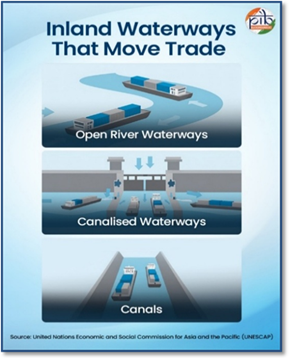
They support commercial transport that ranges from natural river routes to completely engineered channels, and are commonly classified into three main types:
- Open River Waterways are natural rivers where vessels operate in a largely free-flowing channel, with limited improvements made to maintain sufficient depth for movement.
- Canalised Waterways are rivers that have been modified using structures such as locks and dams, which divide the river into calmer sections and provide more reliable water levels for transport.
- Canals are man-made waterways built specifically to carry vessels, often to avoid natural barriers or to connect different rivers and lakes, offering fully controlled conditions for inland water transport.
If an inland waterway forms a boundary between two countries, it is recognised as belonging to both. The World Bank emphasises that waterways offer several additional functions. They promote tourism through recreational boats, leisure spaces and fishing. They aid water management by helping with flood control, irrigation, industrial use and household needs. They also protect ecosystems by maintaining wildlife habitats and supporting nature conservation. Waterways further enhance real estate potential, provide space for housing boats and create river island areas.
Transportation through Inland Waterways
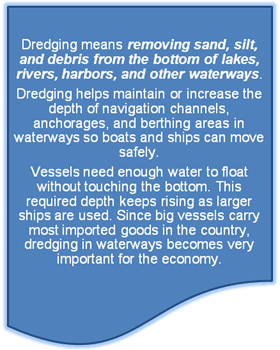
The International Labour Organization (ILO) emphasises that transport through inland waterways is more sustainable, with energy use about 3-6 times lower than road transport and up to 2 times lower than rail. It also produces less noise and fewer emissions. A standard inland vessel with a carrying capacity of about 2,000 tonnes can replace nearly 125 trucks of 16-tonne capacity each, highlighting its efficiency in bulk cargo movement. From an economic view, inland water transport (IWT) is also lucrative because it uses natural routes and needs less infrastructure. Its operating costs are lower than land transport, and it mainly competes with road and rail. It usually carries a small share of passengers, even in regions where it is common, but it plays a much bigger role in moving freight. Furthermore, the World Bank states that inland waterways require some essential facilities for smooth operation. These include ports, terminals, connecting roads or rail links, navigation aids and regular dredging to keep enough depth. Other transport options often face traffic and limited space. Inland waterways offer a more dependable option with more predictable travel and have much more room to grow because many routes are still unused.
Development of Inland Water Transport (IWT) Infrastructure
The Government of India is consistently working to develop the Inland Water Transport (IWT) sector. Three basic IWT-related infrastructures are essential for developing waterways:
- A fairway or navigational channel with the required width and depth
- Terminals for vessel berthing, cargo loading and unloading, and links to road and rail
- Navigational aids that support the safe movement of vessels
Inland waterways, compared to other modes of transport, offer additional infrastructure, supplementary vessel capacity, and lower social costs.
A legal framework has been established in the country to enhance transport on inland waterways and certain coastal routes. This framework provides a coordinated plan for developing transport services on these routes. It also guides the creation of the infrastructure needed for smooth operation. All development under this framework follows internationally agreed performance standards and parameters.
In addition to these developments, India has set a target to raise the Inland Water Transport modal share from 2 per cent to 5 per cent and expand cargo volumes to more than 200 MMT by 2030 and 500 MMT by 2047, as envisioned in the Maritime Amrit Kaal Vision. Priority is being given to highway projects that connect ports, Inland Water Transport terminals, and industrial corridors in order to reduce overall logistics costs.
Inland Waterways in India
The National Waterways Act, 2016, declares 111 inland waterways as ‘National Waterways (NWs) across the country to stimulate shipping and navigation. The total length of these NWs is 20,187 km, and they are spread across 23 States and 4 Union Territories of India. As of March 2026, 32 National Waterways are operational, spanning 5,155 km in the country for cargo and passenger movement, and the number is proposed to increase to 52 in the next 5 years. Operational waterways are considered to have the essential facilities needed for safe and regular vessel movement. These include a fairway with adequate depth and width, functioning terminals that support vessel handling, and reliable navigational aids. When these elements reach a usable stage, organized operations can begin, allowing both mechanized vessels and country boats of different capacities to move along the route. With these core facilities in place, a waterway becomes viable for inland water transport and encourages private investment in inland vessels based on market demand. Ongoing projects across National Waterways continue to develop and maintain fairways, terminals, and navigation systems so that more waterways can achieve operational status.
Operational NWs in India (as of March, 2026)
| S. No. | State(s) | NW No. | Limits of NW |
| 1 | Andhra Pradesh | NW-4 | Krishna-Godavari River Systems |
| 2 | Assam | NW-2 | Brahmaputra River (Dhubri-Sadiya) |
| 3 | NW-16 | Barak River | |
| 4 | NW-31 | Dhansiri / Chathe | |
| 5 | NW-57 | Kopili River | |
| 6 | Bihar | NW-94 | Sone River |
| 7 | Goa | NW-68 | Mandovi River |
| 8 | NW-27 | Cumberjua River | |
| 9 | NW-111 | Zuari River | |
| 10 | Gujarat | NW-48 | Jawai-Luni-Rann of Kutch River |
| 11 | NW-73 | Narmada River | |
| 12 | NW-87 | Sabarmati River | |
| 13 | NW-100 | Tapi River | |
| 14 | Kerala | NW-3 | West Coast Canal |
| 15 | NW-8 | Alappuzha-Changanassery Canal | |
| 16 | NW-9 | Alappuzha-Kottayam-Athirampuzha Canal | |
| 17 | Maharashtra | NW-10 | Amba River |
| 18 | NW-53 | Kalyan-Thane-Mumbai Waterway, Vasai Creek and Ulhas River | |
| 19 | NW-83 | Rajpuri Creek | |
| 20 | NW-85 | Revadanda Creek-Kundalika River System | |
| 21 | NW-91 | Shastri River-Jaigad Creek System | |
| 22 | Odisha | NW-5 | East Coast Canal and Matai River/Brahmani-Kharsua-Dhamra Rivers/Mahanadi Delta Rivers |
| 23 | NW-14 | Baitarani River | |
| 24 | NW-23 | Budha Balanga | |
| 25 | NW-64 | Mahanadi River | |
| 26 | Uttar Pradesh | NW-110 | Yamuna River |
| 27 | NW-40 | Ghaghra River | |
| 28 | Uttar Pradesh, Bihar, Jharkhand, West Bengal | NW-1 | Ganga-Bhagirathi-Hooghly River System (Haldia-Allahabad) |
| 29 | West Bengal | NW-44 | Ichamati River |
| 30 | NW-47 | Jalangi River | |
| 31 | NW-86 | Rupnarayan River | |
| 32 | NW-97 | Sundarbans Waterway |
|
An Overview of Inland Waterways and Their Network in India |
Cargo Movement and Revenue Outcomes on National Waterways
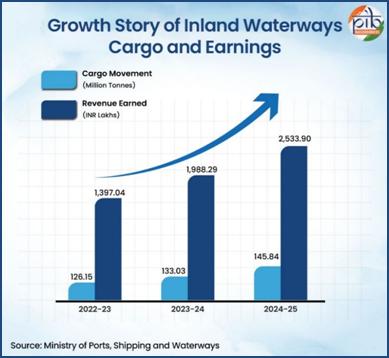
Waterways can carry up to four times more cargo using the same amount of fuel, making them a cost-effective option for trade. They also use less energy, create less noise, and produce lower carbon emissions, making water transport a cleaner and more dependable way to move goods. According to the Economic Survey 2025-26, as of November 2025, cargo operations are functional on 29 National Waterways, cruise operations on 15 National Waterways, and passenger services on 23 National Waterways. A total of 11 National Waterways support all three modes of transport, namely cargo, cruise, and passenger movement, signifying strong multimodal integration. Passenger traffic has also grown significantly, increasing from 1.61 crore in 2023-24 to 7.6 crore in 2024-25. Cargo transportation on NWs reached 145.84 million metric tonnes in the financial year 2024-25, and 198 MMT (till February 2026) in the financial year 2025-26. The combined cargo handling capacity of major ports rose from 555 million metric tonnes per annum (MTPA) in FY 2013-14 to 1,681 MTPA in FY 2024-25. Moreover, the turnaround time for container vessels declined substantially from 41.76 hours in 2013-14 to 28.5 hours in 2024-25. The steady growth shows that inland waterways are becoming an increasingly important, efficient, and environmentally friendly way to move goods across India.
|
Key Initiatives, Schemes and Projects |
The Government has undertaken a series of legislative, policy, and programme-based initiatives to develop and strengthen inland water transport (IWT) in the country. These measures focus on infrastructure development, cargo movement, sustainability, tourism promotion, and regional connectivity.
The Inland Waterways Authority of India Act, 1985
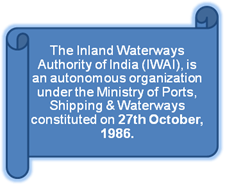
The Inland Waterways Authority of India Act, 1985, enacted on 30 December 1985, provides for the creation of a dedicated authority to regulate and develop inland waterways for shipping and navigation, along with related activities. Under this Act, the Inland Waterways Authority of India (IWAI) was established by the Central Government through an official notification to develop and regulate inland waterways for shipping and navigation. The IWAI mainly works on developing and maintaining infrastructure for inland water transport (IWT) on national waterways.
National Waterways Act, 2016
The National Waterways Act, 2016, enacted on 25 March 2016, provides the legal framework for the continuation of the first 5 National Waterways, which had earlier been declared through separate Acts, and further declares 106 additional waterways as National Waterways. The Act also lays down provisions for their regulation, development, and maintenance to support shipping and navigation, along with other related matters. If Parliament declares any other waterway as a national waterway by law, then from that date, the waterway is treated as a national waterway. The rules of this Act then apply to it with the required changes. The date of that declaration is taken as the date from which this Act applies to that waterway.
Jalvahak-Cargo Promotion Scheme, 2024
Introduced on 15 December, 2024, the Jalvahak scheme promotes a strategic transition of cargo to inland waterways by providing incentives to vessel operators and supporting scheduled cargo services on NW-1, NW-2 and NW-16 via the Indo-Bangladesh Protocol (IBP) route. The scheme has also been proposed to be extended to waterways in the state of Kerala, by the Hon’ble Minister of Ports, Shipping and Waterways, during the 3rd IWDC Conference. Under the scheme, up to 35% of the actual operating cost of a waterway journey is reimbursed. The scheme is expected to shift about 800 million tonne kilometres of cargo to inland waterways, which is nearly 17% of the total cargo movement currently carried on National Waterways.
National Waterways (Construction of Jetties/Terminals) Regulations, 2025
The National Waterways Construction of Jetties and Terminals Regulations 2025 have been introduced to make it easier for private companies, government bodies, and joint ventures to build jetties and terminals on national waterways across the country. The regulations encourage greater private sector participation in infrastructure development on NWs, helping to improve transport and logistics efficiency.
The Inland Vessels Act, 2021
The Inland Vessels Act, 2021, was adopted on 11 August 2021. It supports safe and economical transport and trade through inland waters. It brings uniform rules for inland waterways across the country. It ensures safe navigation and protects life and cargo. It also reduces pollution from the use of inland vessels. The Act promotes transparent and accountable administration of inland water transport. It strengthens the rules for vessel construction, survey, registration, manning, and navigation, along with other related procedures. The Central Government may allow other authorities to exercise its powers under this Act. The Inland Waterways Authority of India remains the competent authority for carrying out powers and duties under this Act.
The Coastal Shipping Act, 2025
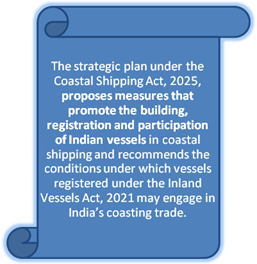
The Coastal Shipping Act, 2025, introduced on 9 August 2025, states that the Central Government publishes a National Coastal and Inland Shipping Strategic Plan within two years of the Act’s commencement, and updates it every two years. The Strategic Plan identifies coastal shipping routes, including those that overlap with inland waterways, and specifies the operational improvements needed to make coastal maritime transport more cost-efficient for goods and passengers. It includes long-term traffic forecasts for both coastal shipping and the inland waterways network, and identifies best practices that improve performance through better synergy with inland waterways and other modes of transport. It also identifies new coastal routes and integrates them with existing routes.
Harit Nauka Inland Vessels Green Transition Guidelines
Launched on 8 January, 2024, the Harit Nauka Inland Vessels Green Transition Guidelines provide a strategic framework for making inland water transport cleaner, more efficient, and future-ready in line with India’s National Maritime Vision.
| Key Provisions and Targets of the Harit Nauka Inland Vessels Green Transition Guidelines | |
| Focus Area | Key Provisions / Targets |
| Green Vessel Ecosystem | Promotion of green inland vessels, supporting infrastructure, and development of an operational ecosystem. |
| Alignment with Maritime India Vision 2030 | Supports the objectives of Maritime India Vision 2030 by promoting a higher share of inland waterways in the national transport system and encouraging greater cargo movement. |
| Alignment with Maritime Amrit Kaal Vision 2047 | Aligns with the long-term goals of Maritime Amrit Kaal Vision 2047, which aims for a complete transition to green inland vessels and a significant expansion of inland waterway cargo capacity. |
| Linkage with Sustainability | Builds upon earlier sustainability initiatives, including the Harit Sagar Guidelines 2023, by extending green practices from ports to inland vessels. |
| Complementary Programmes | Complements the Green Tug Transition Programme, ensuring a consistent approach to decarbonisation across maritime and inland water transport. |
| Carbon Intensity Targets | Targets 30% reduction in carbon intensity of inland waterway-based passenger transport by 2030 and 70% reduction by 2047 |
| State-Level Transition Roadmap | Serves as a roadmap for States to shift 50% of passenger fleet to green fuels by 2033 and 100% by 2045. |
| Vessel Greening Targets | Aims to green at least 1,000 inland vessels over the next 10 years and achieve 100% green vessels across all Indian water bodies by 2047 |
River Cruise Tourism Roadmap, 2047
The River Cruise Tourism Roadmap 2047, launched on 8th January 2024, provides a structured framework to promote river cruise tourism in India. It focuses on four key pillars: infrastructure development, integration, accessibility, and supportive policy measures.
India’s extensive network of NWs, flowing through regions rich in natural beauty, wildlife, and cultural heritage, provides strong potential for cruise-based tourism.
- River Cruise Voyages: River cruise tourism in India has shown strong growth, with the number of river cruise voyages on NWs rising from 371 in 2023-24 to 443 in 2024-25. This 19.4% increase reflects the growing popularity and improved operations of river cruises across the country’s inland waterways.
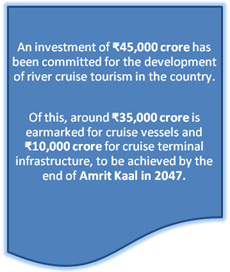
- Expansion of Cruise Vessels: The number of cruise vessels has expanded markedly, rising from 3 vessels in 2013-14 to 25 vessels in 2024-25, operating across 17 circuits on 13 National Waterways in nine states, and supported by the 4,000 km Varanasi-Dibrugarh corridor equipped with 129 terminals.
- Four new cruise terminals at Silghat, Bishwanath Ghat, Neamati and Guijan are proposed to be developed by 2027.
- 34 NWs, along with the Indo-Bangladesh Protocol (IBP) route and two State waterways, have been identified for promoting river cruise tourism.
- At present, river cruise tourism operates on only a few inland waterways in India:
| Waterway | Operational Stretch | Current Status of Cruise Operations |
| NW 1 | Varanasi to Haldia | River cruise services operate on this stretch; however, large cruise vessels generally operate only up to Patna due to depth limitations and pontoon bridges. |
| NW 2 | Guwahati to Neamati | River cruise operations are active on this stretch. |
| NW 3 | Entire stretch | Fully operational for passenger ferry and houseboat services. |
| NW 4 | Selected locations | Passenger ferry services operate at intermittent locations. |
| NW 8 | Alappuzha to Changanassery | Fully operational for passenger ferry and houseboat services. |
| NW 97 | Entire stretch | Fully operational for river cruise movement. |
| Indo-Bangladesh Protocol Route | Cross-border route | Technically feasible; pilot cruise movements have been carried out. |
Initiatives for Upgrading Inland Water Transport Infrastructure in the North-Eastern States
The Economic Survey 2025-26 highlights steady progress in Inland Water Transport (IWT) development across the North-Eastern region. It notes that IWT projects are advancing on National Waterway-2 (NW-2) and National Waterway-16 (NW-16). Additionally, Detailed Project Reports (DPRs) for projects in Nagaland and Mizoram are approaching finalisation. The Survey further records that Tripura is implementing a ₹24.53 crore project to establish connectivity between the Gumti River in India and the Meghna River in Bangladesh. Alongside these developments, several other government initiatives are contributing to the continued expansion and strengthening of Inland Water Transport infrastructure in the North-Eastern States.
| S. No. | Initiatives | Key Components / Details |
| 1 | NW-2 (Brahmaputra River) |
|
| 2 | Ship Repair Facility and Connectivity at Pandu |
|
| 3 | Development of NW-16 (Barak River) |
|
| 4 | NW-57
(Kopili River) |
|
| 5 | Central Sector Schemes (CSS) for IWT in NER |
|
| 6 | River Cruise Tourism Promotion |
|
| 7 | Cruise Terminal Development |
|
| 8 | Religious Tourism Circuit
(SPV-led Initiative) |
|
Jal Marg Vikas Project
The Jal Marg Vikas Project, along with Jal Marg Vikas Project-II (Arth Ganga), is being implemented to improve navigability on National Waterway-1 and to support the socio-economic development of communities along the Ganga River banks.
| Jal Marg Vikas Project on NW-1 | Jal Marg Vikas Project II (Arth Ganga) |
|
|
Key Digital Initiatives
The Government has introduced a range of digital initiatives to modernise inland water transport through technology-driven governance and real-time information systems.
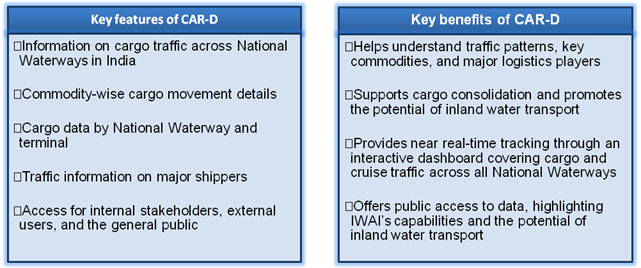
CAR-D (Cargo Data) is a web-based portal developed by the Inland Waterways Authority of India (IWAI) to collect, analyse, and share data on cargo and cruise movement on National Waterways.
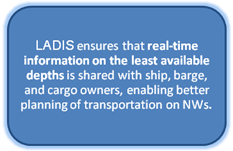
The Least Available Depth Information System (LADIS) has been introduced to share information on the minimum available water depth in navigation channels on selected National Waterways. An assured water depth is essential for the smooth movement of vessels.
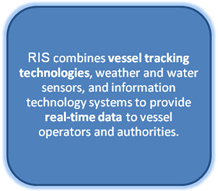
River Information Services (RIS) is an integrated digital system designed to improve safety, efficiency, and traffic management on inland waterways. It enables real-time vessel tracking, monitors waterway and navigation conditions, and provides updates on weather and water levels. It also supports communication between vessels and control centres. As a result, RIS improves navigation safety, reduces delays, supports better voyage planning, and strengthens coordination among stakeholders. Overall, it enhances the reliability and efficiency of inland waterway transport.
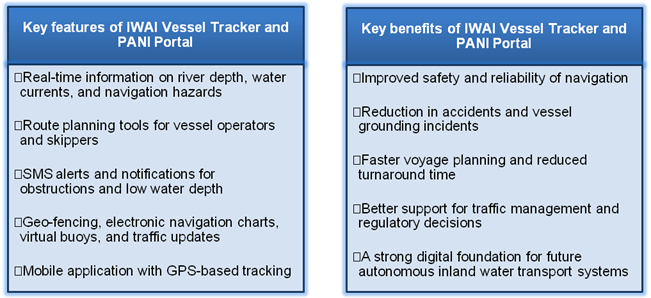
The IWAI Vessel Tracker and PANI Portal together offer a digital solution for e-navigation on inland waterways. They are available as a web portal and a mobile application. The system provides updated navigation routes, water depth information, and real-time vessel tracking to support safe and efficient movement.
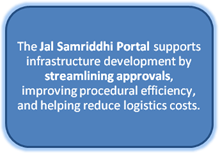
The Jal Samriddhi Portal is designed to facilitate the development of jetties and terminals on National Waterways. It enables private companies, public sector undertakings, government agencies, and joint ventures to apply digitally for a No Objection Certificate (NoC), for construction of the jetties/terminals on National Waterways. It promotes transparency and ease of doing business through a fully digital application process.
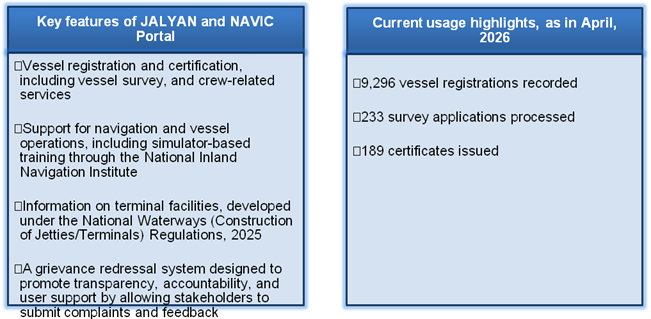
JALYAN and NAVIC Portal supports the growth and regulation of India’s inland water transport sector. It brings together key services related to vessel operations, training, infrastructure, and stakeholder support on a single interface.
|
The Way Forward |
India’s inland waterways journey signifies an evident shift in how the country views its rivers, not merely as natural assets but as active instruments of growth, sustainability, and inclusion.
Through enabling laws such as the Inland Waterways Authority of India Act, 1985 and the National Waterways Act, 2016, a strong institutional foundation has been established for a nationwide waterway network. This framework is being translated into action through focused programmes such as the Jalvahak Cargo Promotion Scheme, the Jal Marg Vikas Project (JMVP), and Arth Ganga (JMVP II), which are strengthening freight movement while reconnecting riverine communities with markets and livelihoods.
Alongside physical infrastructure, the Government has advanced digital governance through initiatives such as CAR-D, PANI, JALYAN and NAVIC, LADIS, River Information Services (RIS), and the Jal Samriddhi Portal, improving safety, transparency, real-time decision-making, and ease of doing business across National Waterways.
Targeted investments in the North-Eastern States underline a commitment to balanced regional development, while the Harit Nauka Inland Vessels Green Transition Guidelines place environmental responsibility at the centre of inland transport growth. In parallel, the River Cruise Tourism Roadmap 2047 unlocks the cultural, heritage, and tourism potential of India’s rivers.
Within this expanding development landscape, the Union Budget 2026-27 proposes to bring new National Waterways into operation, establishing Training Institutes as Regional Centres of Excellence to cultivate specialised skills, creating a ship repair ecosystem, and launching a Coastal Cargo Promotion Scheme that seeks to increase the combined share of inland waterways and coastal shipping.
Flowing through policy, infrastructure, technology, and sustainability, these initiatives collectively shape a future where India’s inland waterways emerge as prevailing passageways of economic vitality, ecological balance, and shared national progress.