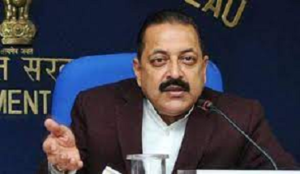
- Technology to Drive Transformation Across the Entire Mineral Resource-to-Metals-to-Downstream Value Chain: Dr Singh
NEW DELHI, 17 September 2026: India seeks technology-driven competitive advantage in mining and metals, and needs to move from a resource advantage to a technology-driven competitiveness, with technology integrated across the entire value chain, from geological exploration and mining to processing, logistics, recycling and downstream manufacturing, Union Minister of State (I/C) for Science & Technology and Earth Sciences and MoS PMO, Personnel, Public Grievances, Pensions, Atomic Energy and Space, Dr. Jitendra Singh, said today while addressing the 3rd edition of FICCI Conference on ‘Digitalization, AI, Automation & Technology Integration in Mining & Metals: Enhancing Competitiveness of the Sector.’
Dr Singh said the competitiveness of the sector would increasingly depend not merely on how much mineral is extracted or metal is produced, but on how efficiently, safely, sustainably and intelligently India converts its geological resources into high-value, resilient and circular material supply chains. He called for moving beyond isolated technology pilots toward connected, scalable and trusted technology systems that can transform the sector at industrial level.
The Minister said India’s mining and metals sector is entering a defining phase as the country moves towards Viksit Bharat 2047, with the sector playing a central role in infrastructure development, energy transition, manufacturing growth, self-reliance and economic development. He said the country’s growth over the past decade, supported by infrastructure, domestic manufacturing, digital infrastructure, innovation and investment, has created the scale and capabilities required for technology-led expansion across major sectors.
The Minister said digital technologies can bring together geological, operational, equipment, process, energy, logistics and market data, enabling faster and more precise decision-making through greater visibility, prediction, coordination and automation. Process technologies can improve extraction and recovery, unlock low-grade ores and residues, reduce energy and water intensity, support lower-carbon metal-making, and strengthen capabilities in separation, refining, advanced materials and recycling, thereby reducing costs and improving competitiveness of Indian minerals and metals in domestic and global markets.
Calling for technology solutions designed around Indian operating realities, the Minister said technology companies and start-ups must take into account varied geology, brownfield plants, tough environmental conditions, affordability, interoperability and scale. “We should not be content only by adopting the next generation of mining and metals technologies. Our ambition should be to develop, demonstrate and scale technologies in India, for India and for the world,” Dr. Jitendra Singh said.
Prof. Gobardhan Das, Member, NITI Aayog said, Mining & Metals must move from Resource Advantage to Technology-Led Competitive Advantage. He added that technology must no longer be viewed merely as a collection of tools or isolated pilot projects, but as a strategic enabler across the mining and metals value chain.
He said digitisation, AI, automation and technology integration can improve productivity, safety, resource efficiency, sustainability and competitiveness across exploration, extraction, beneficiation, refining and recovery. He identified five key elements for the sector’s technology transition: measurable value from technology adoption; trusted data and strong digital foundations; industrial test beds and demonstration partnerships; future-ready talent; and collaboration across the ecosystem. “Success should ultimately be measured not merely by the number of pilots we create, the patents we file or the platforms we develop. It should be measured by whether the technology is validated, commercially adopted and replicated,” added Prof Das.
Mr Subhrakant Panda, Past President, FICCI and Managing Director, Indian Metals and Ferro Alloys (IMFA) Ltd, said the central question for the sector is no longer simply how much it can produce, but how efficiently and sustainably it can do so. “It is not just about the resources below the ground, It is about how effectively we utilise those resources by adopting the latest technology and best practices above the ground,” said Mr Panda.
He added that industry calls for technology to deliver measurable outcomes, and technology adoption must move beyond experimentation. He also emphasised the importance of investment in people alongside investment in machines and software.
Mr Ranjan Dhar, Co-Chair, FICCI Steel Committee and Director & Vice President – Sales & Marketing, AM/NS India, stressed the need for sustained effort and greater technology adoption as India pursues its long-term development ambitions.“There is an immense amount of data available across the industry, and this data can be used to propel ourselves towards efficiencies that can take the industry to the best global standards, not just the best in India, ” said Mr Dhar.
Mr S B Mohanty, Chairman & Managing Director, IREL (India) Ltd, said mining and steel must become more productive, sustainable, safer and agile, with digital transformation serving as a strategic accelerator. The real challenge is scaling it across the organisation as responsible AI, data and digital foundations critical for mining transformation. He said fragmented data, legacy systems, skill gaps and weak cross-functional ownership can limit the impact of digital initiatives.
The conference also witnessed the signing of a Memorandum of Understanding (MoU) between FICCI and TEXMiN (Technology Translation Research Park – TTRP), Department of Science & Technology, Government of India.
FICCI-KPMG report, ‘Mineral Extraction to Metals Production: India’s Technology Pivot for Competitiveness’, was released during the event. The report identifies three priorities: strategic technology leadership, scaling innovations from pilots to commercial deployment, and strengthening the ecosystem for rapid adoption.